
LABEL GUIDES / APPLICATION ENGINEERING
Wet Wipe Resealable Label Selection Guide: Film, Adhesive and Real-Pack Testing
A dependable resealable wet wipe label must be engineered as a complete system—film face stock, resealable adhesive, release liner, actual pouch film and liquid formulation. Because wet wipe lotions, alcohols, surfactants and flow-wrap films vary widely, specialty wet-wipe adhesive constructions should always be quoted per structure and validated on your actual filled pouch before mass production.
Define the label function before selecting adhesive
Wet wipe packs typically use two very different label constructions. Clarifying the function upfront avoids applying a generic room-temperature adhesive to a high-moisture closure.
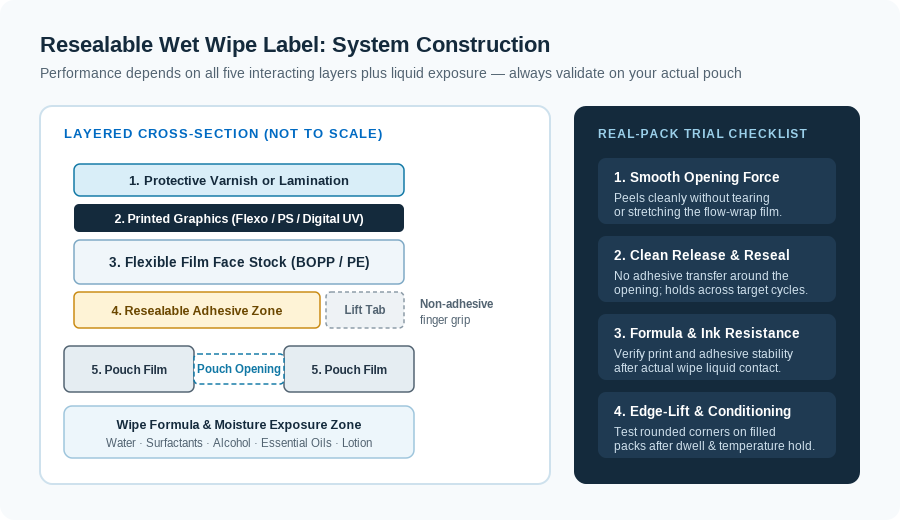
| Label function | Construction elements to review | Failure risks to test against |
|---|---|---|
| Resealable wet-wipe closure | Flexible film face stock (matched to pack stiffness) + specialized resealable adhesive + non-adhesive finger-lift tab + protective varnish or lamination | Adhesive transfer onto pouch film, tack loss after lotion or alcohol contact, corner curl, excessive peel force tearing the pouch, or ink rub-off |
| Permanent outer pack label | Conformable film face stock + permanent adhesive matched to flexible pouch film (e.g. BOPP/PE laminate) | Wrinkling during filling and flexing, edge lift on soft packs, moisture ingress at label edges |
Five engineering inputs needed for an accurate specification
- Actual pouch film surface: Identify the outer layer of the flow-wrap film (such as gloss BOPP, matte BOPP or PET/PE laminate) and any matte lacquer or anti-slip coating—surface energy directly governs peel force and reclosing tack.
- Wipe liquid formulation: Note whether the formula contains alcohol, surfactants, essential oils, disinfectants or heavy lotions. Chemical contact is the leading cause of adhesive softening or ink smudging.
- Lift tab & die-cut geometry: Confirm finished dimensions in millimetres, rounded corner radii (which help reduce edge lift) and the position and size of any deadened finger-lift tab.
- Expected open/reclose cycles & climate: State your target handling requirement, storage temperature and shipping climate. Scope note: Xinxing Label does not make blanket cycle guarantees across all packs without evaluating the proposed construction on your actual pouch.
- Applicator & roll parameters: Confirm hand or machine application, roll core (40 mm or 76.2 mm / 3 inches), max outer diameter (typically 350–400 mm; max approx. 600 mm), unwind direction and minimum 3 mm label gap.
How to run a real-pack sample evaluation
Testing a resealable label on a flat glass plate does not predict how it behaves on a soft, filled flow-wrap pouch. Before bulk release, we recommend a four-step trial plan agreed in advance:
Construction & criteria
Confirm the proposed face stock, resealable adhesive type, protective finish, application conditions, dwell time and pass/fail acceptance criteria before making samples.
Test on filled packs
Supply representative empty or filled pouches so peel force, clean release, pouch integrity and corner stability are observed on the real packaging film.
Check liquid & dwell
Verify print durability and reclosing tack after exposure to the actual wipe liquid and agreed temperature/humidity conditioning.
Explore our in-house label laboratory and production quality control procedures, or review household and wet wipe labels. Raw material supplier TDS and MSDS can be collected upon request for your selected construction.
Frequently Asked Questions
Can a standard removable adhesive be used for wet wipe resealable closures?
Usually not. Standard removable adhesives made for dry retail labels or glass jars often lose tack or leave residue when exposed to wet-wipe surfactants, moisture and repeated pouch flexing. Wet wipe closures require a specialized resealable adhesive matched to your pouch film and formula, quoted and tested per project.
How can I reduce corner curling or edge lift on wet wipe labels during transit?
Use rounded corners rather than sharp 90-degree corners, confirm the pouch film surface coating before finalizing the adhesive, specify a protective lamination or varnish over printed inks, and evaluate samples on actual filled packs after conditioned dwell time before approving bulk production.
What are the MOQ, sampling and lead-time arrangements for custom wet wipe labels?
Xinxing Label does not set a fixed piece-count MOQ; minimum order value depends on the printing process and specialty adhesive availability. Physical sample setup for USD quotes starts from USD 120 per design (non-refundable), with standard stocked constructions typically running 5 to 7 calendar days and specialty wet-wipe adhesive sourcing or custom testing confirmed per order.
Planning a wet wipe resealable label project?
Send your label dimensions, quantity per design, pouch film details, liquid type and roll specifications. We will review suitable constructions and agree on a sample evaluation plan with you.
Explore household & wet wipe labels, check roll specifications, or contact Xinxing Label.